

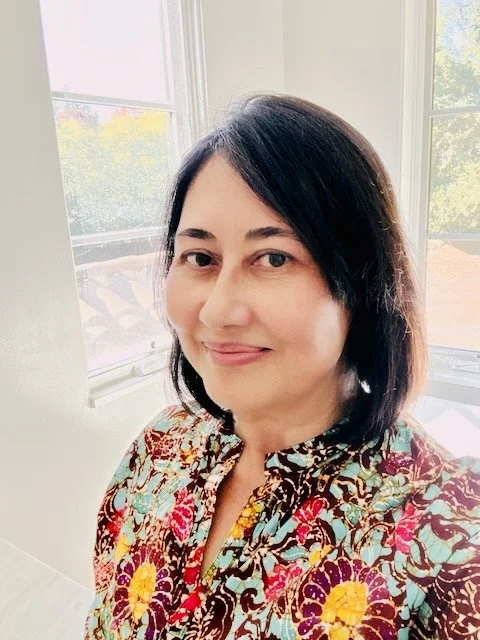
Interview with RTE President Tida Violante
updated December 2025
Q: Tell us about your life growing up and what it was like attending Paly as a high school student yourself.
A: In 1980, I arrived in Palo Alto as a nine-year old child from Bangkok, Thailand, to live with my American father and family. I did not speak any English and he did not speak any Thai so it was a very lonely time and challenging time for me culturally. But at Green Gables Elementary School (now Duveneck), PAUSD provided me with a lovely English teacher, Alice Bulos. Mrs. Bulos pulled me out of my third-grade classroom to teach me English and also American culture. Mrs. Bulos also taught my 9th grade English class. At Paly, I was the class president every year, rally commissioner and student body president, but I still always felt like an outsider. At that time, there was hardly any diversity in Palo Alto as a result of redlining. The Student Activity Director, Mrs. Bakken, a Chinese-American woman, helped guide me through the ups and downs of high school life. My early years in Thailand ingrained in me an awareness of economic disparity and cultural differences. I hoped that by taking on leadership roles, my peers would have greater exposure to and appreciation for others with diverse backgrounds and perspectives. For example, we held candlelit vigils for MLK Day and had chopstick competitions with the football players.
Read the rest of Tida’s interview here.
Q: How did you first hear about RTE and what prompted you to get involved?
A: When I returned to live here in 2019, I was appalled by the lack of low-income housing, the existence of trailers everywhere, and the huge wealth gap that has developed in this region in the past three decades of the growth of Silicon Valley. I saw middle school children with $200 designer t-shirts and I wondered what happened to the grounded Palo Alto that I knew growing up. I wondered how the working class survived here. My children enrolled in PAUSD so I heard about RTE in a Paly e-newsletter asking for volunteers.
Q: How did you make the transition from being a board member to leading the organization?
A: I have held leadership positions at other nonprofits. Academically, I have a doctorate degree in public health leadership and as a lifelong observer, I have very strong ideas about how to involve outsiders and how to change the direction of an organization. Initially, I came on board as the Secretary of the Board of Directors and saw the inner workings of the organization, and where things could be improved. That experience provided a roadmap for me to move over to lead the organization.
Q: What is the most challenging thing about running RTE?
A: We have no paid staff. As with any volunteer organization, it is often challenging to motivate volunteers and to recruit new ones!
Q: Why do you feel so passionately about the work that RTE does?
A: Although money does not buy happiness, it buys stability and peace of mind. I feel so fortunate to be financially secure now and that I did not have to go into steep debt to earn my college and graduate degrees. I want young people who work hard to feel some sense of financial stability that will free them to be the best learners they can be, and allow them to focus on their education instead of constantly worrying about money. The goal is to allow our scholars to be able to graduate on an almost equal footing to their Paly peers.
Q: How has RTE evolved under your leadership?
A: We have increased outreach to the general public, obtained multiple grants from foundations and established a documentation process using the Salesforce platform, so we have more data and evidence of our success. We are able to reach into our database and find college grads and get them involved with RTE. We have also incorporated life skills like networking and preparing for internship and job applications, as well as reinforcing a supportive community.
Q: What are your hopes for the organization in the future?
A: I hope that more former RTE scholars will become further involved in the organization and move it to the direction that they see fit. In addition, we currently have four board members who were RTE scholars. We have engaged them as panelists and workshop presenters and also to do outreach to current scholars. So many of them want to share their experiences with current college students to share their wisdom and challenges. This helps strengthen this community and makes it more welcoming and useful.
Q: What’s the one thing you want people to know about RTE?
A: As an all-volunteer organization, 98% of the funds raised go directly to our college scholars who come from financially difficult circumstances. Some of these students are the hardest working people that I have ever met and they try their best to support themselves and their families with part-time job(s) and still manage to complete college courses! I am incredibly proud of them, almost as if they were my own children! It’s so gratifying to see them in their graduation gowns, knowing RTE supported them in reaching that important milestone!